

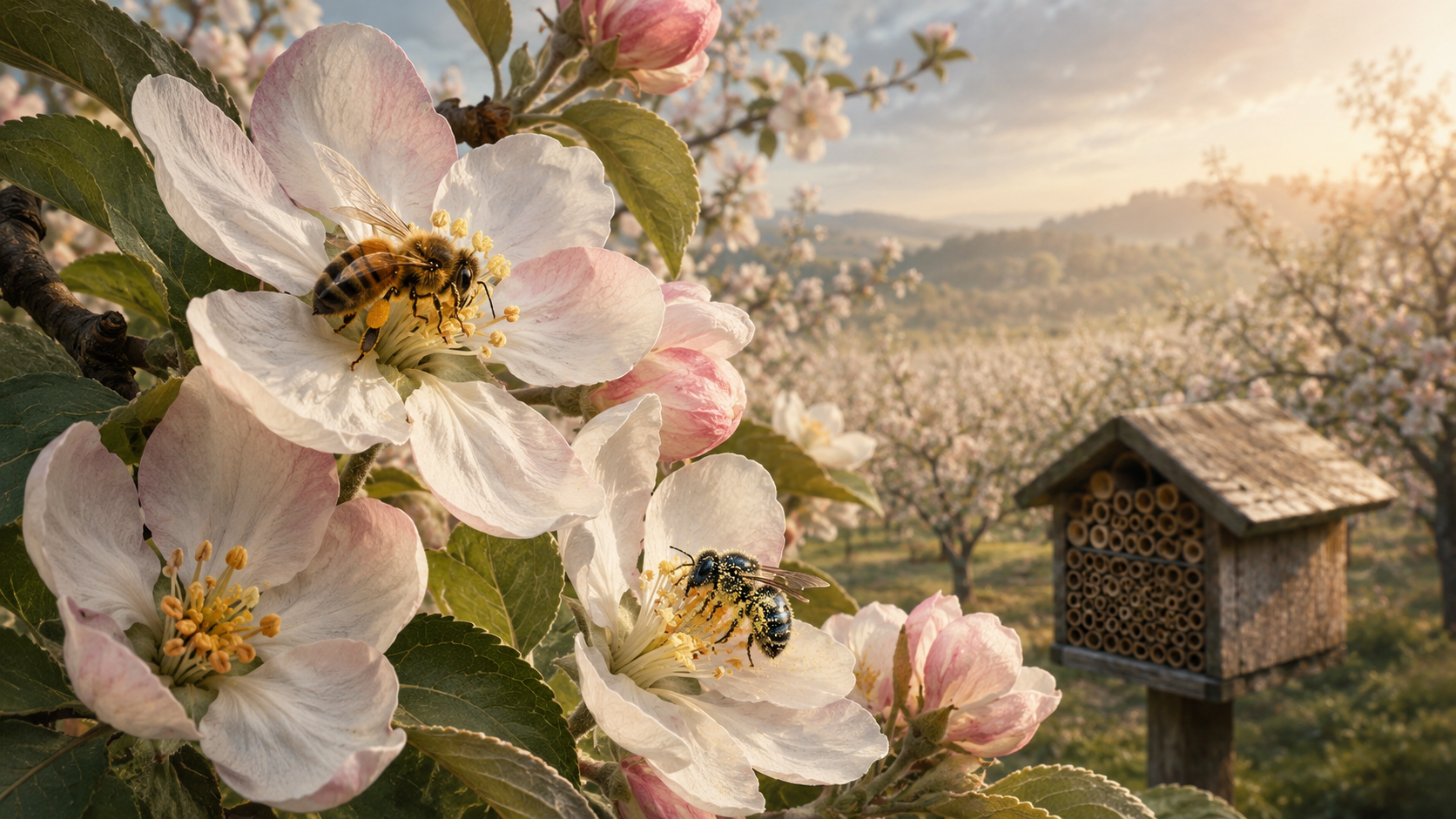
Honeybees are easy to love. They make honey and live in elaborate colonies, communicating through movement and dance. Most importantly they pollinate crops we depend on and flowers we enjoy. For generations, they have been one of the most recognizable symbols of useful work in nature. And lately, they have also become a symbol of concern.
Honeybee colonies face disease, parasites, habitat loss, pesticides, nutritional stress, and other pressures. Managed honeybees remain enormously important to agriculture, contributing billions of dollars in pollination value each year.
So, when someone mentions the Mason Bee Problem, it sounds like one more thing to worry about. Another threat, another invasive species or potentially yet another competitor gaining entrance into an already fragile ecosystem.
Except… the mason bee is not really the problem. In fact, the mason bee may be remarkably good at the very thing we associate most strongly with honeybees.
Pollination.
Mason bees are solitary insects and don’t live in huge colonies. They do not produce honey, nor do they have a queen directing and repopulating thousands of workers. Each female largely goes about her own business, and she is messy. Honeybees are relatively tidy pollen collectors. Much of their pollen is packed into specialized structures on their hind legs. But mason bees carry pollen on stiff hair underneath their abdomen. As they move from flower to flower, that loose pollen comes into contact with the reproductive structures of the plant.
In this instance messy turns out to be useful.
For some orchard crops, mason bees can be extraordinarily efficient pollinators on a bee-for-bee basis. USDA guidance has cited an example in which a few hundred orchard mason bees can effectively pollinate an acre of apples that might otherwise require tens of thousands of honeybee foragers.
They also tend to work in cool or cloudy spring conditions when honeybee pollinating activity may be lower.
None of this makes the honeybee less important.
That would be the wrong lesson.
Honeybees accomplish something mason bees cannot: they operate at enormous scale. Their colonies can contain tens of thousands of workers. They can be managed, moved, and deployed across vast agricultural systems.
They are astonishing creatures. The lesson for us is not that honeybees get too much credit.
It’s that the orchard is bigger than the hive. There are thousands of native bee species in the United States, many contributing to pollination in ways most of us never see.
And that is where the Mason Bee Problem begins.
Because nature has an uncomfortable habit of revealing patterns, we repeat ourselves.
Every community has honeybees; and every community has mason bees. Companies do, churches do, families do, volunteer organizations, schools, clubs, neighborhoods and civic groups do too.
There are people whose contribution is naturally visible; the honeybees...
· They lead.
· They speak.
· They organize.
· They present.
· They represent the group publicly.
· They raise money.
· They make decisions.
· They stand at the front of the room.
Their visibility is not necessarily undeserved. In many cases, visibility is part of their responsibility. They are doing important work.
Then there are the mason bees. They may never stand at the microphone or may not chair the committee. They may not carry the impressive title.
But…
· They notice things.
· They remember things.
· They prepare the room before anyone arrives.
· They quietly teach the new person how things really work.
· They repair something before anyone realizes it was broken.
· They call someone who has disappeared for a few weeks.
· They bring food when someone is sick.
· They know where the missing document is.
· They recognize when a process is beginning to drift.
· They remember why a decision was made ten years ago.
· They hold relationships together in ways that rarely appear on an organizational chart.
A great deal gets pollinated without anyone noticing this bee; and human beings are not particularly good at measuring that kind of contribution. We tend to notice activity that produces evidence.
· A presentation happened
· A sale was made.
· A sermon was preached.
· A project launched.
· A meeting was led.
· A fundraiser succeeded.
Visible work leaves footprints; quiet competence often does the opposite.
· Someone catches the problem before it becomes a problem.
- Nothing happens.
· Someone prevents an argument before it damages a relationship.
- Nothing happens.
· Someone notices the lonely person and quietly includes them.
- Nothing happens.
· Someone maintains a system so reliable nobody ever has to think about it.
- Nothing happens.
Prevention has terrible public relations as does consistency. Sometimes the evidence of good work is simply the absence of bad outcomes.
That creates a peculiar problem.
We may become more aware of the person who dramatically solves a visible crisis than the person who quietly prevented twenty of them.
But this is where we must be careful.
The point is not to divide the world into noble mason bees and attention-seeking honeybees. That would merely create another bad hierarchy and in reality, most of us are both.
In one setting, we may be highly visible… in another, nearly invisible.
Sometimes we carry the work quietly… sometimes we receive credit.
Sometimes we are contributing far more than anyone realizes…
And sometimes we are the person failing to notice what someone else is carrying.
That may be the more useful question.
Not > Am I being appreciated enough?
But > What forms of contribution am I failing to see?
· A leader might ask who everyone calls when something goes wrong.
· A pastor might notice who quietly keeps people connected between Sundays.
· A manager might ask which employee carries knowledge that exists nowhere in the official system.
· A club president might notice who consistently welcomes newcomers.
· A family might recognize the person who remembers birthdays, keeps traditions alive, or quietly absorbs the logistics everyone else assumes simply happen.
Those people are not victims; they are part of the ecosystem. Neither are visible leaders automatically beneficiaries of some unfair system. Often they are carrying burdens that the quieter contributors do not see.
That is why the healthiest response is not resentment, it is connection. The best communities and families learn how different forms of contribution fit together. They create ways for knowledge to move and recognize work before absence reveals its importance.
They make room for quiet contributors to speak and help highly visible people understand what is happening outside their immediate field of view.
And perhaps most importantly they encourage people whose contributions are difficult to see, or communicate, or document, or teach, and share what they know.
The goal is not equal attention; it is better awareness. Recognition does not always mean applause; sometimes recognition means understanding function.
· Knowing who is contributing what.
· Knowing where value is being created.
· Knowing where the system is fragile.
· Knowing which relationships are quietly holding everything together.
The honeybee and the mason bee are not enemies, they simply work differently. One builds a remarkable collective system capable of operating on an enormous scale. The other works largely alone, moving efficiently from flower to flower.
Both contribute to the orchard.
In human communities, the real Mason Bee Problem is that we tend to notice the hive first.
We notice
· Size
· Structure
· Titles
· Visibility
· Activity
And sometimes… we mistake those things for the whole story.
But an orchard is not sustained by what is easiest to see, it is sustained by everything that carries pollen.
The challenge is not deciding which bee is more important but learning to see the whole orchard clearly enough to understand why both equally matter.
And once we achieve that awareness, we become a little better at seeing one another too.