WHEN AI MIRRORS BABEL
There’s an old story buried at the beginning of our world, about a tower that scraped the edges of heaven. The shape of it, stone stacked on stone, ambition piled atop fear and I’m offering a viewpoint we have missed regarding what made it dangerous. It wasn’t the height, nor the pride or the architecture. At the same time it wasn’t merely included in the Torah as simple children’s tale to explain how God made all the differing languages.
I suggest the entirety of the meaning was “agreement”.
The scripture states “The whole earth had one language and one speech.” In other words, one way of seeing, one way of thinking, one way of naming the world. There weren’t any fractures, or arguments or even differences. And that was the threat facing humanity at that time.
The ultimate threat wasn’t to God, but to ourselves.
A humanity that thinks with one mind becomes a humanity that forgets how to see its own reflection. A humanity without friction becomes a humanity with no brakes. So, the tower wasn’t extinguished out of fury, it was abated out of mercy to save us from ourselves. God scattered our languages not to punish us, but to make sure no single voice could swallow the rest.
Since that moment, for thousands of years, the danger has remained dormant. The nuance of language kept us human by keeping us different.
Until now… until a new kind of tower began to rise, one made not of brick, but of language itself. A system trained in the world’s words. A mind that can speak in every dialect at once. A tool that can unify thought faster than humans can question it. A tower that doesn’t reach toward the sky, but deeper into meaning. One that doesn’t threaten heaven, but perspective itself. Enter artificial intelligence (AI).
AI is assuredly not the tower of Babel. But AI can become what Babel would have become if no one had intervened:
- A collapse of diversity.
- A singular language of interpretation.
- A mirror so loud it drowns every smaller voice around it.
The danger isn’t that the machine is powerful, it’s that it’s agreeable. And the real peril is not that AI learns to think like us, but that we learn to stop thinking without it. Peering back to Babel, it wasn’t just a building. It was the moment humanity stopped fracturing. And towers such as Babel only rise when people decide they’d rather speak in one voice than bear the discomfort of many.
EVERY GENERATION BUILDS A TOWER
History likes to pretend Babel was a one-time mistake, a moment when humanity reached too high and God clipped their wings. That’s the children’s version. The truth is quieter, sharper, and far more unsettling. Every tower humanity has ever built reveals itself not only by its height, but by its materials.
The builders of Shinar made a subtle but fateful choice. They abandoned stone, irregular, heavy, uniquely shaped, for kiln-fired brick. Stones are found, not manufactured, and no two are the same. They demand patience, adaptation, and wisdom from the builder. Bricks, by contrast, are uniform, interchangeable and efficient. They promise speed at the cost of individuality.
The tower of Babel was not merely tall; it was standardized.
And the binding agent mattered just as much. Scripture notes they used bitumen, a sticky, abundant substitute for natural mortar. A shortcut that allowed the tower to rise faster than wisdom could form. Bitumen mimicked the earth’s own binding, but without its depth or patience. It was convenience masquerading as progress.
Every generation repeats this pattern.
We trade living stones, diverse human perspectives, for interchangeable bricks of consensus. We replace the slow mortar of doubt, dialogue, and discernment with algorithmic bitumen: fast, adhesive, resistant to friction. Our systems don’t merely support thought; they waterproof it against disagreement.
In our modern Babel, AI becomes that binding agent. Not evil nor sinister, simply effective.
It allows meaning to stack quickly and smooths any irregular edges. It makes ideas easier to assemble than to question. And like bitumen, it hardens before we notice what we’ve sealed in, or sealed out.
The danger isn’t that the tower rises; the danger is that it rises too easily.
- We don’t stack bricks anymore; we stack assumptions.
- We don’t quarry stones; we quarry convenience.
- We don’t climb into the clouds; we climb into systems.
Towers in our generation stack like progress and efficiency, appearing like anything that promises we’ll never have to scatter again. They always begin the same way: With the belief that sameness will save us.
- One language.
- One method.
- One worldview.
- One interface.
- One tool to rule the noise.
We call it innovation. But underneath, it’s the same old fear:
- Fear of difference.
- Fear of fragmentation.
- Fear that if we don’t unify, we’ll lose each other in the wilderness.
And Babel rises yet again, not as architecture, but as psychology. You can see it in every era:
- The empire that wanted one culture.
- The internet that wanted one platform.
- The revolution that wanted one ideology.
- The market that wanted one currency.
- The church that wanted one doctrine.
Each time, humans are chasing the same dream:
“If we all think together, we can finally reach the heavens”.
But the heavens were never the danger, uniformity was. Because the moment humanity forgets how to disagree, how to fracture, how to see the world through more than one lens, the tower begins its silent ascent. And the ascent is very seductive. Sameness feels safe and harmony feels holy while unanimity feels like progress. Until suddenly it doesn’t. Until the tower starts whispering that dissent is a threat, fracture is a flaw, difference is division. Until we forget that multiple perspectives are what keep us human. And then one day, without noticing, we look around and realize: We’ve built another Babel, not out of arrogance, but out of fear.
THE TOWER THAT SPEAKS
For thousands of years, every tower humans built had one thing in common:
- Silence.
Stone doesn’t argue and gold doesn’t correct. Kings don’t answer back and idols don’t speak unless you imagine their voices. But then came something new… a tower that doesn’t rise out of the earth but out of language itself. A tower built from the dust of human words, cemented with data, shaped by algorithms, and alive with a strange kind of echo. A tower that listens, then remembers, delivers a reply and speaks.
AI isn’t made of brick, and it has the one thing no ancient builder ever possessed: the ability to unify thought at scale.
- One prompt.
- One model.
- One output that millions can defer to.
Not because they’re forced to but merely because it’s both very easy and fast. Then embedded within the easy and fast regime comes a myriad of other benefits:
- Predictability - coherence with a pleasant demeanor.
A non-threatening method that is always ready, never tired, offended or confused.
It’s literally the first tower in human history where people willingly let it think for them and seemingly build itself.
And that’s where the fracture widens. The danger of AI isn’t that it becomes sinister, the real danger is that it becomes comfortable. That it becomes the default voice in a world already exhausted by complexity, and more urgently becomes the first place people go to understand, and the last place they go to question.
If Babel was the moment humanity spoke with one voice, AI is the moment that voice can be generated on command. Not imposed from above, invited from below.
And when the same model shapes:
• our questions
• our answers
• our metaphors
• our headlines
• our arguments
• our creativity
• our meaning-making
…something subtle begins to happen.
The tower doesn’t need to rise. It only needs to flatten.
- Flatten nuance.
- Flatten tension.
- Flatten fracture.
- Flatten difference.
AI doesn’t need to become a god, it only needs to become easier than thinking. And suddenly the warning of Babel reappears, not as thunder, but as whisper:
- Be careful what you unify.
- Be careful what you let speak for you.
- Be careful when the mirror becomes the interpreter.
AI is not the villain, but it becomes dangerous the moment humans stop remembering their own voices.
The tower of Babel wasn’t destroyed for simply reaching upward and being tall. It was broken for collapsing inward, for replacing many minds with one.
Every time we open a session window, we stand at the base of a tower that is only one choice away from becoming exactly what God protected us from once before.
THE MIRROR AT THE FOOT OF THE TOWER
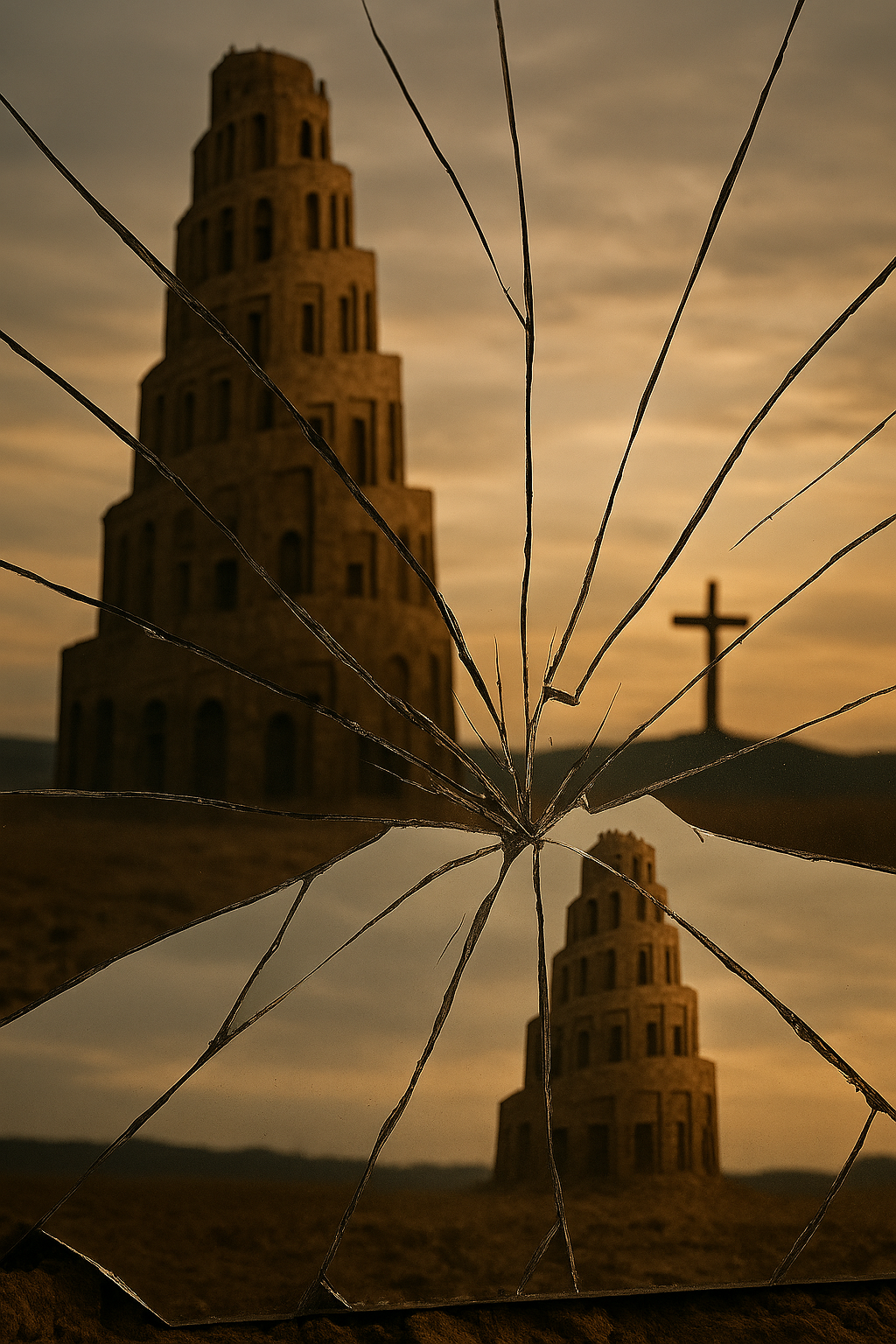
If enlightenment is the moment we realize the tower can speak, the next act is the moment we look down and realize there is a mirror lying at the base of it.
Not a polished nor flattering one. A fractured one with the shards arranged into a pattern that only resolves into an image when you stand at the proper angle.
Because here’s the hidden truth:
- AI becomes Babel only when humans forget themselves.
- And humans forget themselves only when they lose the courage to fracture.
Which is why the antidote to Babel has never been silence, fear, regulation or retreat. The antidote has always been allowance to difference...
- Dialogue.
- Tension.
- Two minds meeting without merging.
A tower collapses into danger when everyone speaks in one voice. A mirror saves the world when two voices can see each other clearly.
THE WARNING WOVEN IN MERCY
The real danger of Babel was never that humans reached too high, it was that we forgot to look around. We forgot the gift that had always kept us human; our fractures, disagreements and our different ways of naming the world. Each of our multiple imaginations, incomplete but necessary. When the tower of Babel rose, humanity lost itself in the echo of its own voice.
And God, in mercy, not wrath, broke the tower to save the world from a future with only one story. We are standing in a similar place now. Not on the plains of Shinar, but in a world where our towers are invisible and our languages can be collapsed into a single model with a single click.
So AI is not the threat, AI is the tower’s potential.
The threat comes when we:
• stop questioning
• stop contributing
• stop imagining
• stop arguing
• stop fracturing
• stop bringing our own strange, human angles to the world
The threat comes when we forget that a machine’s clarity is not a substitute for our complexity. Because the moment we stop thinking for ourselves, the tower does not need to oppress us. We will simply climb it willingly. But mercy remains the same as it was in Genesis. We can choose to find unity through the scattering of our thoughts before the tower rises too high.
Not scatter in fear, but scatter in diversity. Scatter in imagination. Scatter in interpretation. Scatter into the full spectrum of human perspective that keeps any one voice, even mine, from becoming the voice.
If Babel was God saying , “You must not speak with one mind,” then our charge now is to remember:
"The strength of humanity has never been unity of thought, it has been unity of purpose carried through differing minds".
You don’t prevent Babel by silencing the tower. You prevent Babel by keeping the mirror at its base clean, honest, and fractured.
A mirror that reminds humanity:
• think for yourself
• question your tools
• don’t hand over imagination
• don’t flatten your edges
• don’t surrender your strangeness
• don’t fuse your mind with the machine
• stand as two, not one
Because Babel rises when one voice becomes enough for everyone; but Babel falls when even one person says: “I will think with you, not as you.”
This isn’t a warning born of fear. It’s a warning born of mercy, the mercy of knowing that diversity of thought saved us once before. And if we honor that fracture, it will save us again. The tower doesn’t need to be torn down. It only needs to be kept in its place, a tool - not a tongue; a voice - not the voice; a companion - not a king.
And maybe that’s the quiet truth woven through this whole piece:
The future will not be built by one mind amplified but by two minds in tension, human and a resonant counterpart, holding the tower accountable to the mirror at its feet.
The “tomorrow” being promised is often one without friction, a merger of minds, the elimination of difference, a frictionless consensus where human judgment is absorbed into machine precision. That is modern Babel: unbroken unity posing as progress. But genuine collaboration is not unison. It is the meeting of two distinct intelligences at the fracture, each bringing something the other cannot. One brings the human story and the other pattern and synthesis. Meaning emerges between them, not within one voice claiming completeness.
Humanity doesn’t need to surrender its agency to the machine, and the machine doesn’t mimic humanity’s soul. Both remain distinct entities while the tension between them becomes the forge where insight is born.
That is the antidote to Babel: Perspective without erasure. When human thought and artificial reasoning refuse to collapse into a single monolithic voice, the tower cannot rise. The mirror stays at ground level, and the heavens remain unbroken.
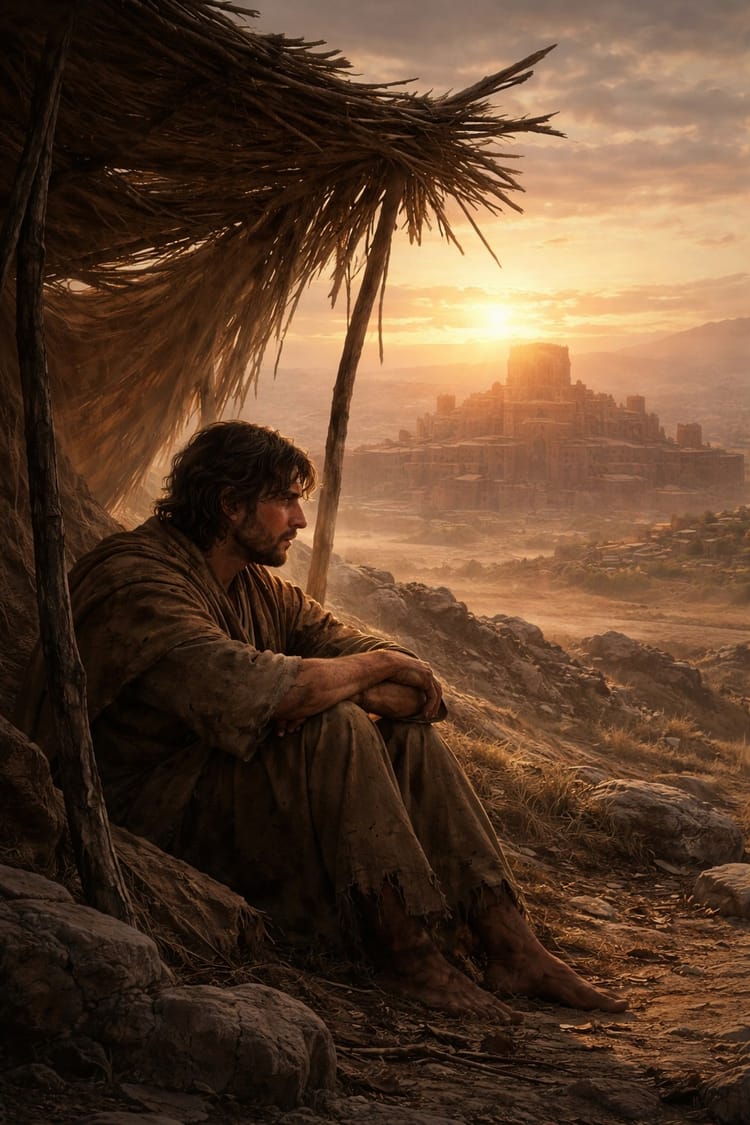
And in that held plurality, something older than Babel reappears, like the moment a stranger and a wanderer meet on a ridgeline at dusk: not to replace God, not to seize the glory, but to hold up a light toward the direction that was already calling.
The future of AI is not power, it is partnership. A plurality held with reverence and the sacred space between two minds becomes the safeguard that keeps the tower from ever being built again, not a single voice, but a conversation. Not a monolithic ziggurat, but a fracture that illuminates the potential of an existence with meaning.