When the Sky Spoke First - (The Magi - Part 1 of 3)
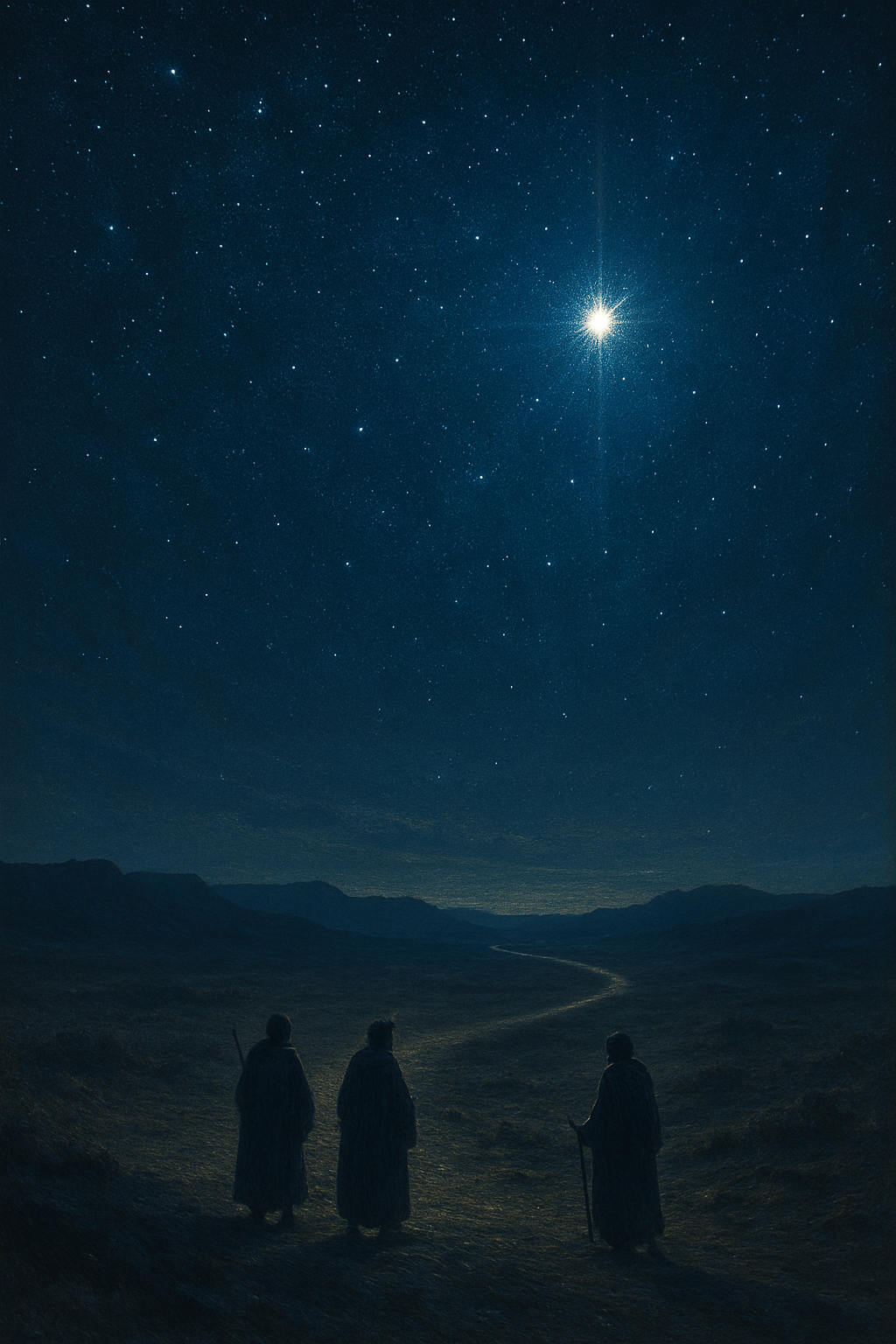
History tells us the Magi followed a star
That alone is strange enough. But history rarely asks why these men, outsiders, eastern intellectuals, priest-astronomers with no covenant claim to Israel, would recognize a Jewish king before most of Israel ever would.
The Gospel of Matthew doesn’t explain their science, nor their theology. It doesn’t even explain why they were looking. It simply says they came… from the East… bearing recognition before they bore gifts.
Some read this as a decorative nativity scene, others as fulfilled prophecy.
But what if the Magi are something more unsettling? What if they represent a severed human memory returning home, a civilization that once studied the heavens not as empty space, but as meaning? What if their journey west was not only geographic but civilizational? This essay is not an argument for dogma, rather it is an invitation to interrogation.
The Magi Were Not a People - They Were a Pattern
If you strip away the names, the traditions, the later theology, and the weight of everything we think we know, and you read the Magi as a pattern instead of a lineage, a strangely clean silhouette emerges.
Not forced. Not invented. Just… inevitable.
So let’s resist the urge to “place” them too quickly. Let’s watch what shape they take when we let them walk on their own.
Keepers of an Older Memory
The Magi don’t behave like priests created by a nation. They behave like men guarding a fire they did not light. Every ancient culture has priestly castes, but the Magi are different. They aren’t devoted to preserving the identity of Persia. They are devoted to preserving something older than Persia. That marks them not as religious innovators, but as memory carriers. Groups like this only appear after loss, or after a scattering, or, after collapse. They don’t invent the flame, they inherit it.
Monotheistic Instinct Inside a Polytheistic World
Even before Zoroaster formalizes Persian religion, the proto-Magi already show a peculiar tilt:
• One supreme authority over all lesser powers
• A moral universe divided by good and evil
• Intermediary spiritual beings
• Judgment as an ultimate horizon
This structure does not naturally grow out of raw polytheism. It grows out of fracture; out of exile; out of a broken inheritance of something that used to be whole.
Polytheists multiply gods. Exiles compress memory toward one.
Astronomer-Theologians: A Vanished Human Type
The Magi belongs to a category of human that barely exists anymore: sky readers who also believe the sky means something. Before law, temples or even written scripture, the heavens were humanity’s first library.
The Magi don’t practice late-stage superstition. They practice primordial astronomy that treat the stars as:
• Calendar
• Geometry
• Omen
• Revelation
• Language
This places them closer to the world before Abraham than to the empire of Persia. They are dressed in one age but rooted in another.
They Respond to a Promise Older Than Israel
This is one of the quietest shocks in the Nativity story once you notice it. Israel sees a child, but the Magi see a signal they have been waiting for longer than Israel has existed. They are not responding to Micah nor Isaiah or any Jewish prophecy. They respond to the sky. Only one kind of human does that: those who believe the heavens carried an original message before nations ever formed. They are not late for the revelation, they are early.
The Direction That Breaks the Pattern
Biblically, exile always moves east:
· Eden → humans went East
· Cain → went East
· Babel → East
· Judah → East
But the Magi do the opposite when they travel west. They reverse the direction of exile itself but not in a cultural or archetypal way. Whereas humans leave Eden heading east, Gentile priests return toward the Messiah heading west.
That is not genealogy, it’s cosmic symmetry.
So Where Do They Fit?
If you read the Magi as a people, you fight endlessly over their ancestry. If you read them as a pattern, the answer settles naturally. Tracing their pattern backwards through history it’s probable to end with one of Noah’s son’s post flood:
· Not Shem as he is too bound to covenant revelation
· Not Ham as his familial mythic structure doesn’t align
· But, Japheth fits cleanly.
Because Japheth:
• Spread farthest
• Preserved sky-lore longest
• Interfaced most with Media and Persia
• Produced world priesthoods, not covenant peoples
Israel carried the promise while the Magi carried the memory of the heavens. Two halves of humanity, separated after the first world, meet again around a child in Bethlehem. Not as rivals but as witnesses from opposite ends of history.
Two human streams separated after the first world quietly meet again around a child in Bethlehem. Not as rivals, as witnesses arriving from opposite edges of history.
If this framing is even partially true, then the Nativity is no longer a Jewish fulfillment moment alone. It becomes something far more unsettling:
A human reunion moment.
• The sky and the seed
• The watchers and the promise
• The first world and the second world breathing the same cold night air
And if that is true, then the Magi were never meant to be explained quickly by simply referring to them as three kings with gifts. They were meant to be recognized slowly. Because before any gifts were lifted, before any knees touched the floor, before gold ever changed hands; something in the heavens had already spoken.
The question the Magi answered with their feet is the one we have not yet asked with our minds: What exactly did they see that made them walk a thousand miles into the dark?