
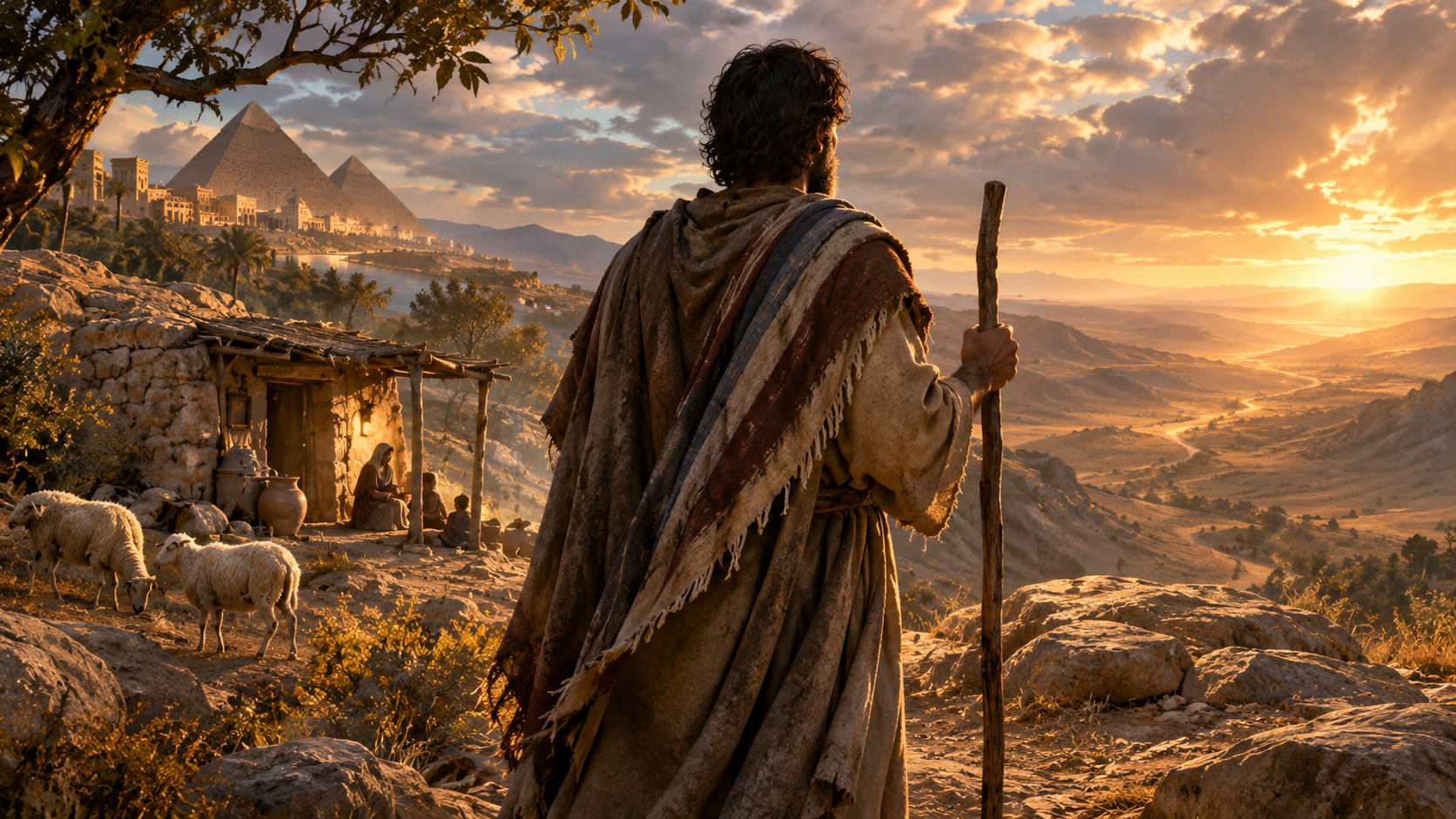
A Dispute Over Moses; What If It Was About Becoming?
A Familiar Scene with a Missing Detail
In the Biblical writing of Jude verse 9, when an archangel named Michael contested with the devil over the body of Moses, it’s commonly thought Moses was dead, but is that a safe assumption to hold?
It sounds like an odd question as most of us already know the scene or think we do. Moses has died; his burial place is unknown. Then somewhere beyond human sight, Michael and the devil contend over what remains of him. It is a familiar explanation for this verse, and it may be correct.
But I keep returning to a curious omission in the verse. Jude names Michael, the devil, Moses' body, and the words Michael speaks: “The Lord rebuke you.” He never tells us when the dispute happened. He never explains what the devil wanted.
Deuteronomy 34 describes Moses' death and burial, so a dispute after his death is a natural reading. Ancient Jewish traditions about Moses' final fate make it more than an arbitrary assumption. Still, the scene in our imagination contains details Jude does not actually supply.
What happens if, just for the sake of investigation, we remove one of them?
What if Moses was alive during the engagement?
A Dispute Over Someone Who Could Still Choose
The word Jude uses for “body,” the Greek sōma, does not by itself settle whether a person is living or dead. Context must do that work. And Jude's brief reference gives us less context than we might wish.
There is precedent in Scripture for a supernatural challenge concerning a living person. In the opening of Job, the adversary questions Job's loyalty before God. Job has no idea this exchange is occurring yet he encounters its consequences in the unfolding of his life. While Job doesn't explain Jude, it reminds us that a person need not be dead to become the subject of a dispute he cannot see.
A more striking parallel appears in Zechariah 3.
The prophet sees Joshua the high priest standing before the angel of the Lord, with Satan there to accuse him. Joshua is wearing filthy garments. The Lord rebukes the accuser, and the garments are removed. The passage explicitly presents their removal as the taking away of Joshua's guilt.
Then come the words that stopped me: “The LORD rebuke you.”
Jude uses essentially the same words in describing Michael's response to the devil.
The resemblance is too specific to ignore, yet not enough to identify the two events. Joshua is a living priest in a prophetic vision; Zechariah does not name Michael, and Jude does not tell us the charge against Moses. The texts share a distinctive appeal to God's authority, not an established common chronology.
But Zechariah gives us something valuable: a picture in which accusation, standing before God, and continued service are at issue for someone who is still alive.
That possibility sent me back to Moses.
The Man Who Had Lived Three Lives
Before Moses ever stood before Pharaoh, he had already lived across worlds that did not fit neatly together.
He was Hebrew by birth, raised in an Egyptian royal household, and later established a life in Midian. He had known privilege, fled after killing an Egyptian, married Zipporah, become a father, and tended sheep far from the place that formed him. Then God called him to go back to Egypt.
Read Moses' response in Exodus 3 and 4. He asks, “Who am I?” He worries that the Israelites will not believe him. He protests that he is not a capable speaker. Finally, he asks God to send someone else. We can absolutely see his reluctance but hidden from our view is its source.
Was Moses afraid of Pharaoh? Of rejection by the Hebrews? Of failing at something far larger than himself? Or was he being asked to become someone he could not yet reconcile with the life he had built? Those questions are not answers disguised as questions. Exodus gives us his objections, not a modern psychological profile. Yet I cannot help noticing the direction of his journey. God calls Moses back toward the place from which he fled, but not to resume his former life. The man who had escaped Egypt would now be asked to confront it.
And then, before he even arrives, the narrative abruptly stops.
The Lodging Place
Exodus 4:24–26 is among the strangest episodes in Moses' story.
At a lodging place on the road, the Lord encounters someone and seeks to kill him. The pronouns leave some uncertainty about who is threatened. Zipporah takes a flint knife, circumcises their son, touches the foreskin to someone's feet, and speaks of a “bridegroom of blood.” The danger passes.
We are given no recorded argument between Moses and Zipporah. We are not told why the child's circumcision had not already occurred. Nor are we given enough information to reconstruct Zipporah's emotions or the family's private history.
But the interruption is there; and Zipporah is the one who acts.
The bodily sign of covenant appears at the very moment Moses is moving toward his public assignment. Whatever else this episode means, it confronts the household with a covenant question that cannot be postponed.
I've begun to think of the lodging place as a semicolon in Moses' story: no longer the life he had settled into, not yet the work he had been sent to do. That is a metaphor, not a claim about what the Hebrew word secretly means. Yet it captures something of the uneasy pause.
Moses is between places. Might he also be between understandings of himself?
I am not proposing that Exodus story explicitly describes Michael and the devil at this campsite. It doesn't. The Hebrew account attributes the threat to the Lord. That is a substantial difficulty for anyone who would identify this episode as Jude's dispute.
There is, however, an intriguing ancient witness to a different way of imagining the scene. The Book of Jubilees, an early Jewish retelling of biblical history, describes Prince Mastema seeking to kill Moses as he returns to Egypt, at the lodging place. That tradition places supernatural opposition during Moses' life, precisely as his mission is beginning.
It does not mention Michael's dispute in Jude. It does not resolve the difference between Mastema in Jubilees and the LORD in Exodus. And it cannot prove that Jude is recounting the same event. Still, the connection is worth noticing. An ancient interpreter could look at this roadside crisis and see an adversarial force opposing the living Moses.
The Third Person in the Dispute
Here is where my perspective began to change. In the usual picture of Jude 9, Michael and the devil are the active figures. Moses is dead, the subject of their argument.
But if Moses was alive, the picture becomes more complicated. What if Moses was not simply being disputed over, but was himself struggling to answer the calling before him?
Perhaps the devil, in the hypothetical scene we are considering, opposed the future Moses had been called to enter. Perhaps Michael's resistance concerned that opposition. And perhaps the human dimension of the conflict appeared in Moses' own hesitation, fear, and decisions.
I cannot demonstrate any of that from Jude. He does not say what the devil wanted, that Michael defended Moses' freedom to choose, or that Moses knew a dispute was occurring. It would also be a mistake to cast Moses' ordinary family life in Midian as something evil that God needed to destroy.
What I am asking is narrower, and to me more interesting.
What if the real issue was not simply who possessed Moses, but who Moses was becoming?
Being called and answering a calling are not identical things. One may happen in an instant. The other may demand that a person walk back toward old fears, face unfinished obligations, and let familiar explanations of who they are become insufficient.
Moses had already been chosen for a mission. Yet the story still gives us a man who argues, hesitates, travels, faces a crisis, and depends on the decisive action of another person.
Whatever happened in the unseen world, the visible story does not describe effortless transformation.
When the Question Comes Home
I began this investigation wondering whether Moses was alive during Jude's dispute.
But the question has slowly become personal.
Most of us carry several versions of ourselves. There is the person shaped by where we came from, the person we learned to be in order to survive, and the person we sense we ought to become.
Those identities do not always agree.
We can mistake a familiar life for a finished one. We can also mistake every restless ambition for a divine calling. Discernment matters; discomfort by itself is not proof that God is directing us somewhere.
Still, when an honest obligation or a difficult change stands before us, how often do we answer as Moses did?
- Who am I to do this?
- What if nobody believes me?
- What if I'm not capable?
- What if someone else could do it better?
These are not foolish questions. Sometimes they are responsible ones. But sometimes we keep asking them long after we understand what is being asked of us. And that leaves me wondering whether a person can spend years defending an identity that was only ever meant to carry them to the next part of their life.
There may be no angelic argument over our shoulders and we should not try to invent one. But the struggle to answer what is before us is real enough. Perhaps the question to ask ourselves is not merely, Who am I? Perhaps it is, What am I refusing to become?
Back to Michael
Before we let that thought take us too far, we should return to Jude.
The letter is not primarily about Moses' inner life. Jude is warning believers against people who abuse grace, reject authority, and speak with a confidence they have not earned. His example is Michael, an archangel who, even in dispute with the devil, does not presume to issue his own reviling judgment. He says, “The Lord rebuke you.”
I find that restraint particularly important now.
We have entertained an unusual possibility. It has taken us through Job, Zechariah, Moses' hesitation, Zipporah's intervention, and an ancient retelling of the lodging-place encounter. It might illuminate something, it might also be wrong.
Michael's words remind me that not every mystery gives us authority to pronounce a verdict.
Perhaps Moses was dead when the dispute occurred. The traditional reading has serious reasons behind it. Other interpreters have proposed that the dispute concerned Moses' bodily entrance into God's presence. The full story Jude's readers may have known has not survived for us to inspect.
Yet a question worth asking can remain worth asking even when it cannot be settled.
When I read Jude 9 now, I still see Michael and the devil. But I also find myself wondering about Moses before Pharaoh, the man caught between the life he knew and the responsibility waiting ahead.
And the question follows me beyond the verse:
- Am I so certain about who I have been that I can no longer recognize who I am being called to become?
Jude gives us only twenty-five verses. I suspect there is more to discover in them than one mysterious dispute. Perhaps that is where the next exploration should begin: not by assuming we have solved verse 9, but by returning to the entire letter and allowing its warnings, its calls to mercy, and its closing promise of preservation to speak for themselves.
For now, I want to leave Moses on the road to Egypt; not because I know what Michael and the devil were arguing about. But because Moses was still on his way… and what might a corpse be of value for anyway…